

Flow Traders
Flow Traders is a global financial technology company and leading liquidity provider, operating across traditional financial markets and digital assets. Headquartered in the Netherlands, the company uses technology and market expertise to facilitate trading and provide liquidity across global markets.
Case study
Developed as part of an interview assignment for Flow Traders, this case study explored how to communicate the launch of a 24/7 OTC liquidity offering for tokenized assets.
The objective was to develop an external communications strategy that would position Flow Traders as a trusted liquidity provider in the evolving tokenization market, while reaching institutional counterparties, digital asset companies and the wider financial industry.
My approach combined audience research, strategic messaging, creative direction and multi-channel communications planning. I developed a campaign concept and rollout strategy across LinkedIn, X, Substack and the corporate newsroom, adapting the messaging to different audiences and platforms.
The case study also included visual campaign concepts, a communications timeline, legal and compliance considerations, and a measurement framework focused on brand awareness, audience engagement and qualified business interest.
The brief
With tokenized markets expanding, demand will rise for after hours trading and hedging opportunities. As a result, providing these clients with execution and risk management becomes necessary. We want Flow Traders to offer this as a service through our digital asset OTC desk.
Core message
Flow Traders aims to give to the institutional clients access to after hours OTC liquidity as tokenized markets continue to develop.
Audiences
Counterparty institutions
Banks brokers and asset managers that qualify to be counterparties. We want to educate them on what we are offering and what assets we can execute in and open up dialogue.
Digital asset space
Any company that creates or allows for digital assets. Issuers, exchanges and providers. We want them to know that Flow Traders is involved in tokenization and want to establish credibility.
General public/industry
Media and other members of the financial industry. We want to inform them why this news is important and generate conversation and hopefully some earned media.
How I defined the audiences
When looking at this news release I wanted to know who is going to use this. Who is making it happen and who is telling the story to everyone else.
Who is going to use this - Our audience is any institution that qualifies to be a counter party. We will be educating them on our offering, what we have available to trade and executing trades.
Who is making it happen - When launching this product there will be specific assets that we will be naming as well as their issuers. There will also be exchanges and other companies that allow us to offer this service. We want these companies to know that we are involved in the tokenization space and want to build credibility.
Who is telling the story to everyone else - As we are selling a product to institutions we don't want a story to get out of hand. So we want to provide media with the correct information on why this news is relevant. Hopefully leading to earned media.
Once I knew who my audiences were I could figure out what I want them to take away from the message. Which allowed me to identify what each channel will be used for.
Channels
The main channel to launch and build credibility with institutions.
X
Amplifies Flow Traders’ voice and joins relevant industry conversations.
Substack
Deeper insight into tokenization and market structure, through existing content or follow-up explainers.
Corporate newsroom
The reference point for the full announcement, with details and context.
Creative
The idea for the design was a globe that was lit up. To represent the global market being open at all times. There were 4 points I wanted to get across in the image:

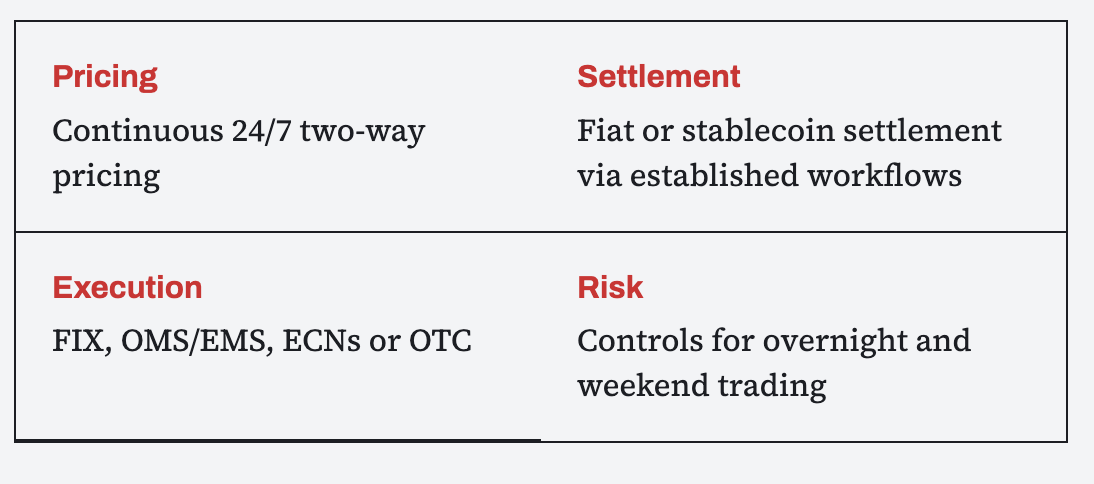
The concept
Copy was adjusted to each platform. On Linkedin Iprovided more background on what our CEO thinks about staying exposed to equities around the world. On X I just had the product name and asset. I used one pull quote and directed people to the press release.

Rollout plan
How I built it
I worked backwards from the risks of this launch. It’s a regulated, institutional product, and the message (“24/7 liquidity”) is easy to misread. So I asked what has to be true before anything goes public, what has to happen on the day, and how to learn from the response afterwards. That gave five stages, each with one job.
Preparation (T–48 to T–24 hours)
What: Develop copy, assets, links and tracking, assign publishing responsibilities, and align with legal and compliance on claims, supported assets, partners and eligibility.
Why it helps: Most of the risk sits in the claims, so I put compliance alignment first, before anything is polished. Fixing a wording issue at T–48 costs nothing, while fixing it after publication costs credibility. Tracking is set up now so launch-day data can be measured properly.
Validation (T–24 hours to launch)
What: Final approvals, link and format checks, amplification coordination, and prepared answers to expected questions with escalation routes.
Why it helps: This stage separates “written” from “safe to publish.” Planning answers in advance means the team isn’t improvising on eligibility or regulatory questions in public. Coordinating amplification here means partners and stakeholders post the approved version.
Announcement (launch day)
What: Publish the newsroom release and the LinkedIn and X posts, coordinate approved amplification, and monitor engagement, referral traffic and misinformation.
Why it helps: The newsroom release is the source of record, and the social posts link back to it, so every channel points to the same accurate details. Monitoring on the day catches misreadings of “24/7” while they can still be corrected quickly.
Additional context (Day +1 or +2)
What: Publish Substack content or a follow-up explainer, informed by the questions the audience asks.
Why it helps: Institutional audiences want depth that a social post can’t carry. Waiting a day or two means the explainer answers real questions instead of guessed ones, and it extends the story beyond launch day.
Evaluation (Day +3 and +5)
What: Review results with stakeholders and optimise based on audience quality and meaningful engagement.
Why it helps: For a niche institutional audience, a few relevant enquiries matter more than a large number of impressions. Reviewing twice (early signal, then a fuller picture) gives time to adjust distribution or messaging while the news is still fresh.
Measurement
How I built it
I started with a question: what does success look like for a niche, institutional product? Reach alone doesn’t answer it, because a post seen by thousands of people who can never trade with Flow Traders isn’t a win. So I set up three levels that follow the audience’s path from noticing the announcement, to understanding it, to showing real interest.
Awareness
What: Reach, impressions, industry amplification and earned media coverage, measured on LinkedIn, X and media monitoring.
Why it helps: This shows whether the news got into the right conversations. I included industry amplification and earned coverage, not just impressions, because a pickup by a credible voice matters more than raw numbers.
Understanding
What: Announcement clicks, click-through rate and meaningful engagement, measured through social analytics, website analytics and Substack.
Why it helps: A click means someone wanted the full details, which is the point of the newsroom release. Meaningful engagement (thoughtful comments, questions, shares from relevant people) tells you whether the message was understood or misread.
Qualified interest
What: Relevant enquiries, referral traffic to product and contact pages, and follow-up conversations, measured through website analytics, CRM and internal sales feedback.
Why it helps: This is the level tied to the business objective. Including sales feedback means the measurement doesn’t rely on dashboards alone, since the people talking to counterparties can say whether the enquiries were the right ones.
Principle: Each level has named tools, so the plan can be tracked in practice. I set the review criteria around audience quality, not vanity metrics, so a small number of relevant enquiries counts as a better result than a large, irrelevant audience.
Risks and response
I asked what could go wrong for this specific launch, and I started with the nature of the product: regulated, available only to eligible counterparties, and easy to oversimplify as “trading 24/7.” Each risk has a response that can be carried out, and most of them prevent the problem before launch, not just react to it.
Misinterpretation of 24/7 liquidity
Response: Communicate eligibility criteria and product limitations clearly.
Why it helps: “24/7” can sound like it’s open to everyone, at any time, in any conditions. Stating who has access and what the limits are in the announcement itself reduces misreading and the follow-up questions that come with it.
Inaccurate claims
Response: Verify every product and partner reference with product and legal/compliance before publication.
Why it helps: The posts name specific assets and partners, so one wrong detail could reflect badly on Flow Traders and the partners. This links back to the compliance alignment in the first stage of the rollout plan.
Regulatory or eligibility questions
Response: Refer enquiries to designated internal experts and avoid public speculation.
Why it helps: Social teams shouldn’t answer regulatory questions on the spot. Naming who answers gives the team a clear next step and keeps public statements accurate.
Low engagement
Response: Review audience relevance, distribution and message clarity before adjusting the campaign.
Why it helps: Low numbers can have several causes: wrong audience, weak distribution or an unclear message. Diagnosing first prevents changing the wrong thing, and it fits the niche audience, where small numbers aren’t automatically a failure.
Negative or misleading discussion
Response: Monitor conversations, reply based on approved information, and escalate material issues where necessary.
Why it helps: Replying only from approved information keeps the company’s public statements consistent. Escalation routes were prepared in the validation stage, so the team knows who decides when something serious appears.
A short reflection
What I’d focus on in a real launch: getting legal and compliance alignment early, because the biggest risk in this kind of announcement is a claim that’s slightly wrong, and tracking qualified enquiries from the start so the evaluation isn’t based on reach alone.
What I’d highlight
This is a regulated, institutional product, so I built compliance review and clear eligibility language into the plan from the first step, and set success around qualified enquiries rather than reach alone.
Prepared as a case study for a Flow Traders interview process. It is an independent concept: Flow Traders did not commission or approve it, and the engagement figures shown in the mockups are illustrative.